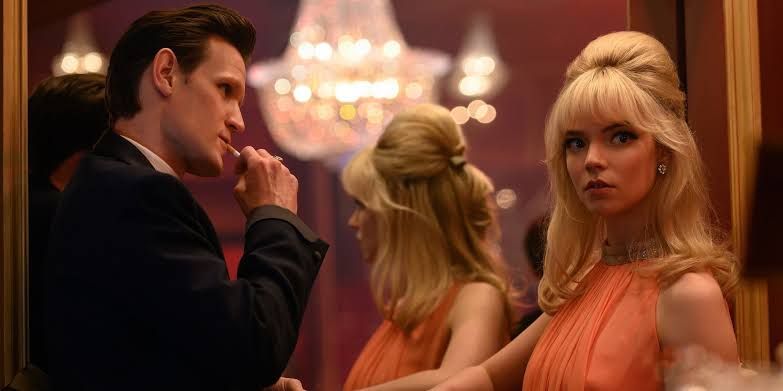
Edgar Wright's "Last Night in Soho" unfolds as a visually ambitious attempt to intertwine dreams, illusions, and the haunting specters of the past within a classic coming-of-age framework. Yet, this cinematic venture finds itself entangled in the delicate balance between its epigrammatic conceit and its execution, resulting in a narrative that occasionally falters in conveying its intended message.
The film follows Eloise Turner (Thomasin McKenzie), an eighteen-year-old aspiring fashion designer, on her journey from provincial life to the vibrant metropolis of London. The script, co-written by Wright and Krysty Wilson-Cairns, expands the coming-of-age concept into a social history infused with horror-movie tropes. Eloise's dreams become a canvas where the stifled nightmares of swinging London manifest, demanding her confrontation for eventual success.

Eloise's character is shaped against the backdrop of her grandmother Peggy's (Rita Tushingham) nostalgic reverence for the mid-sixties' swinging London. Raised on the music and myths of that era, Eloise enrolls in the London College of Fashion to bring her retro visions to life. However, the backstory behind her quest feels somewhat borrowed and formulaic, following the trajectory of a heroine's journey for ancestral redemption.
The narrative takes an intricate turn as Eloise's life in the city transforms into a haunted-house tale. An array of contrived setups, from a tumultuous dormitory experience with the vain Jocasta (Synnove Karlsen) to a coincidentally preserved sixties-style room owned by Ms. Collins (Diana Rigg), creates a complex web that adds layers of complication. The film's dream sequences, featuring Eloise as a spectral observer of Sandie (Anya Taylor-Joy) in mid-sixties London, inject a surreal and captivating element into the storyline.
LAST NIGHT IN SOHO (2021)
While the visual aesthetics, including the juxtaposition of modernity and retro charm, contribute to the film's allure, the ambitious narrative occasionally loses its coherence. Eloise's silent witness to Sandie's tribulations, set against the backdrop of degradations and dangers, leads to a desperate yet futile attempt at intervention.
"Last Night in Soho" navigates the clash between dreams and reality, unveiling the misogynistic underbelly of swinging London. However, the film's significant and worthy ideas find themselves somewhat stifled by the intricate web of setups and dream sequences. Despite its occasional disconnect, the movie remains an enigmatic and visually captivating exploration of the complexities between past and present, dreams and nightmares.